NAS Sync Mini Server
ESP32-Based Mini Network Attached Storage & Media Server
Verified Technologies Used
This project is an educational and developmental prototype designed for experimentation on a trusted local network (LAN). It is not engineered as a production-grade, hardened public NAS; it does not implement enterprise SSL/TLS certificate chains, multi-tenant RBAC, or wide-area network security hardening.
Local Storage Without Power Overhead
Small lab environments and home development setups frequently need rapid, driverless file sharing and media streaming across devices without keeping a high-wattage desktop computer or expensive commercial NAS running 24/7.
Low-Power ESP32 Web Storage Host
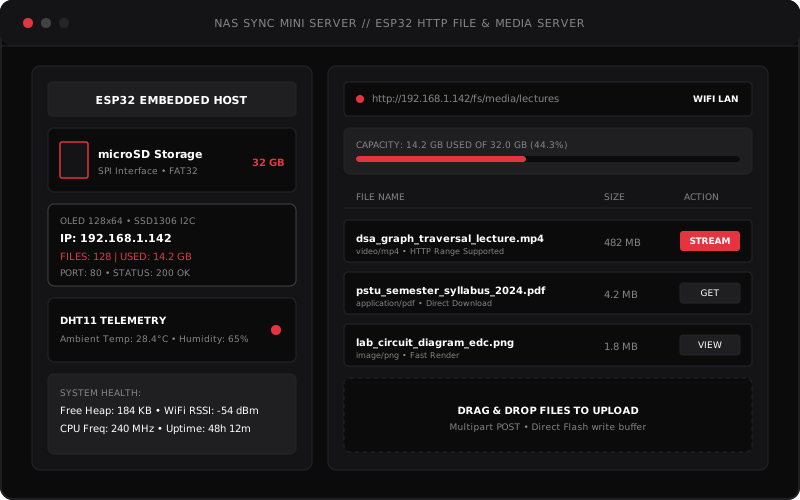
NAS Sync Mini Server transforms a 3.3V ESP32 microcontroller into a self-contained web file host. Connected to a FAT32 microSD card, it serves a responsive browser interface for drag-and-drop uploads, streaming audio/video, document viewing, and file organization.
OLED Screen & Environmental Telemetry
A compact 0.96-inch I2C SSD1306 OLED displays current assigned local IP, connected clients, and remaining storage capacity in real time. A DHT11 sensor logs ambient room temperature and humidity, surfaced directly through the dashboard.
In-Browser Media & Transfer Progress
Client devices require no special client apps—any web browser connects to the local IP to browse folders, preview images, stream MP4/MP3 media directly, download datasets, and monitor upload progress with transfer-rate telemetry.
Key Engineering Takeaways
- Microcontroller Memory Constraints: Engineered chunked streaming buffer routines to prevent ESP32 heap exhaustion when streaming large multi-megabyte media files over HTTP.
- SPI Bus Stability: Configured high-speed SPI pinouts and decoupling capacitors to maintain signal integrity during prolonged microSD write cycles.
- Asynchronous Concurrency: Leveraged dual-core ESP32 architecture using `ESPAsyncWebServer` to keep the OLED telemetry display and sensor updates smooth during active file transfers.